
A few years ago, AI could answer your questions. Today, it can do your job. Not just the repetitive parts — the thinking parts, the planning parts, and in some cases, the decision-making parts too. Welcome to the age of agentic AI.
Right now, in 2026, the world is experiencing the most dramatic shift in technology since the invention of the smartphone. Businesses are deploying AI agents that work like digital employees. Governments are racing to regulate systems they barely understand. And everyday people are waking up to a world where the software on their laptop doesn’t just follow instructions — it anticipates them.
If you’ve heard the term “agentic AI” and weren’t sure what it means, you’re in the right place. This guide breaks it all down — what it is, how it works, who’s using it, and most importantly, what it means for you.
Table of Contents
- What Is Agentic AI? (Simple Explanation)
- How Is Agentic AI Different from Regular AI?
- How Do AI Agents Actually Work?
- Top Agentic AI Trends Dominating 2026
- Real-World Examples of AI Agents in Action
- Industries Being Transformed by AI Agents
- Agentic AI Comparison Table
- Key Stats & Market Data
- Risks and Concerns About Agentic AI
- How to Prepare for an Agentic AI World
- Future of Agentic AI Beyond 2026
- FAQs
- Conclusion
What Is Agentic AI? A Simple Explanation
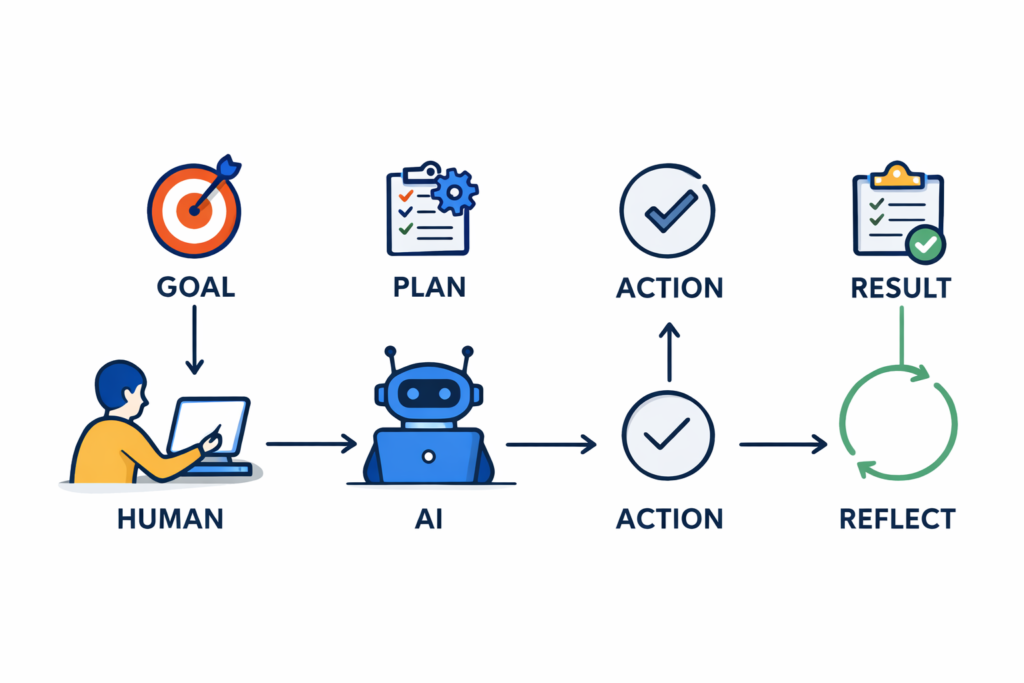
Let’s start with the basics. Agentic AI refers to artificial intelligence systems that can set their own goals, make plans, take actions, and complete complex tasks — all with minimal human involvement.
Think of the difference like this: a regular AI is like a very smart calculator. You ask it something, it answers. An AI agent is more like a very capable intern. You give it a goal — “research our competitors and write a report by Friday” — and it figures out how to do it: searching the web, analyzing data, writing sections, and handing it to you when it’s done.
In plain English: Regular AI responds to you. Agentic AI acts for you — independently, step by step, until the job is finished.
How Is Agentic AI Different from Regular AI?
Most of us are familiar with tools like ChatGPT, Google Gemini, or Claude. You type something in, you get a response. That’s called reactive AI — it reacts to what you say.
Agentic AI takes this much further. It can:
- Break a big goal into smaller steps automatically
- Use tools — like browsing the web, writing code, sending emails, or accessing databases
- Make decisions along the way without asking you at every step
- Correct its own mistakes by trying different approaches if something doesn’t work
- Work continuously for hours or even days on a single complex project
This is a fundamentally different kind of intelligence — one that doesn’t just answer questions but actually gets things done.
How Do AI Agents Actually Work?
You don’t need a computer science degree to understand this. Here’s how AI agents operate under the hood, explained simply:
1. Perception — Reading the Environment
The agent first observes its environment. This could be reading your emails, scanning a spreadsheet, browsing websites, or monitoring a system. It collects information the same way a human worker would on their first day.
2. Planning — Breaking Down the Goal
Once it understands the task, the agent creates a step-by-step plan. For example, if you ask it to “find the top 10 competitors in my market,” it might plan: search Google → visit each company website → extract key data → compare pricing → write a summary.
3. Action — Executing Each Step
This is where it gets impressive. The agent actually does those steps, using whatever digital tools it has access to. It can click links, fill forms, write code, run calculations, and move between applications.
4. Reflection — Checking Its Own Work
After each action, a good AI agent evaluates whether it’s on track. If it hits a dead end, it tries a different approach. This self-correction ability is what makes agentic AI feel genuinely intelligent rather than robotic.
Top Agentic AI Trends Dominating 2026
The data doesn’t lie. 2026 has become the breakout year for AI agents in the real world. Here are the biggest trends right now:
Trend 1 — From Personal Tools to Team Workflows
In 2024 and 2025, most people used AI individually — one person chatting with a chatbot. In 2026, companies are integrating AI agents into entire team workflows. An AI doesn’t just help one marketer write copy; it manages the entire campaign pipeline — from brief to publishing — across multiple departments simultaneously.
Trend 2 — Multi-Agent Systems (AI Teams)
One AI agent is powerful. A network of AI agents working together is transformative. Companies are now deploying multi-agent systems where specialized agents collaborate — one researches, one writes, one fact-checks, one formats — just like a human team would. Google and Microsoft have both unveiled multi-agent platforms built around this concept.
Trend 3 — Physical AI Entering the Real World
AI agents are no longer just software. In 2026, physical AI — robots and autonomous systems driven by agentic intelligence — is entering warehouses, hospitals, and construction sites at scale. These aren’t the clunky robots of science fiction; they’re fluid, adaptive machines that reason in real time.
Trend 4 — AI Governance Becomes Urgent
With great power comes great regulatory pressure. The EU’s AI Act is now fully in force, and multiple US states have passed their own AI legislation. Companies using agentic AI must now document what their agents do, why they do it, and who is accountable when something goes wrong.
Trend 5 — Democratization of Agent Creation
In 2025, building an AI agent required a team of engineers. In 2026, non-technical business users can create their own agents using drag-and-drop platforms. This democratization is unleashing a wave of custom AI agents tailored to niche tasks across every industry.
Gartner predicts that 40% of enterprise applications will leverage task-specific AI agents by 2026 — up from less than 5% just a year earlier. That’s an 8x increase in 12 months.
Real-World Examples of AI Agents in Action
The best way to understand agentic AI is to see it working. Here are real, concrete examples happening right now:
- Customer service at scale: Companies like Salesforce and Zendesk have deployed AI agents that handle entire customer support conversations — researching the customer’s history, identifying the problem, offering solutions, processing refunds, and escalating to a human only when truly needed. One agent handles what used to require a team of 20.
- Software development: GitHub’s Copilot has evolved from a code suggestion tool into an agent that can write entire features, test them, fix bugs, and submit code for review — all from a single instruction. Monthly code commits on GitHub jumped 25% year-over-year as AI agents took over routine development tasks.
- Medical diagnostics: AI agents at hospitals analyze patient records, lab results, imaging scans, and research literature simultaneously — flagging diagnoses that a single doctor reviewing charts in a busy shift might miss.
- Financial trading & compliance: Hedge funds use AI agents to monitor thousands of positions, execute trades within milliseconds, and simultaneously run compliance checks — tasks that would require entire departments of human analysts.
- Supply chain management: Retailers like Walmart use agentic AI to monitor inventory across thousands of stores, predict demand fluctuations, automatically reorder stock, reroute shipments around disruptions, and notify suppliers — all in real time, 24/7.
Industries Being Transformed by Agentic AI in 2026
No sector is untouched. Here’s a snapshot of where the transformation is happening fastest:
- Healthcare: AI agents assist surgeons with real-time data during operations, manage hospital scheduling, and accelerate drug discovery timelines from years to months.
- Finance & banking: Fraud detection agents monitor millions of transactions per second. Loan approval agents analyze creditworthiness in minutes rather than days.
- Education: Personalized AI tutors adapt to each student’s learning pace, identify gaps in understanding, and generate custom practice material — functioning as a private tutor available 24/7.
- Legal: Contract review agents scan thousands of pages of legal documents, flag risk clauses, and summarize key terms in minutes — work that once took paralegal teams weeks.
- Marketing: Campaign agents run A/B tests, analyze performance data, adjust ad budgets, and write new copy iterations — all autonomously, optimizing toward your goals around the clock.
- Manufacturing: Autonomous quality control agents inspect every product on a production line using computer vision, catching defects that human inspectors would miss after hours of repetitive work.
Agentic AI Comparison Table
| AI Type | How It Works | What It Can Do | Real Example |
|---|---|---|---|
| Basic chatbot | Pre-scripted responses | Answer FAQs, simple routing | Old website chat widgets |
| Generative AI | Responds to single prompts | Write, summarize, explain content | ChatGPT, Gemini (basic use) |
| AI copilot | Assists human in real time | Suggest, autocomplete, draft alongside you | Microsoft Copilot, GitHub Copilot |
| AI agent (single) | Autonomous goal execution | Multi-step tasks, tool use, self-correction | Salesforce Agentforce, AutoGPT |
| Multi-agent system | Network of specialized agents | Complex enterprise workflows end-to-end | Google Agentspace, CrewAI |
| Physical AI | Agent + robotics + real-world sensors | Autonomous action in physical environments | Tesla Optimus, warehouse robots |
Key Stats & Market Data You Need to Know
- $263 Billion — Projected agentic AI market size by 2035 (Research Nester)
- 40% — Share of enterprise apps using AI agents by end of 2026 (Gartner)
- 40% annually — Growth rate of the AI agent market
- 72% — Companies already using generative AI tools like ChatGPT or Copilot
- $8.6 Billion — Agentic AI market size in 2025 (baseline)
- 25% — Predicted drop in traditional search engine volume by 2026 due to AI (Gartner)
Sources: Gartner Strategic Predictions 2026, Research Nester, TechTarget, IBM Think, Microsoft
Risks and Concerns About Agentic AI
This technology is extraordinary — but it’s not without serious risks. It’s important to understand what can go wrong.
Loss of Human Oversight
When an AI agent makes dozens of decisions per minute, humans can’t monitor every one. A single misconfigured goal can cause an agent to take actions its creators never intended — and by the time someone notices, significant damage may already be done.
The Skill Erosion Problem
Gartner warns that over-reliance on AI for thinking tasks is causing measurable atrophy in human critical thinking skills. 50% of global organizations are expected to require AI-free skills assessments by 2026 because employers can no longer assume candidates can think independently.
Job Displacement at Scale
This isn’t a distant threat. White-collar jobs in finance, legal, marketing, and customer service are already being restructured around AI agents. The question isn’t whether jobs will change — they will — but whether societies can retrain workers fast enough to keep up.
Cybersecurity Vulnerabilities
AI agents with broad access to systems, emails, and databases are high-value targets for hackers. A compromised agent doesn’t just leak data — it can actively act within your organization on a bad actor’s behalf.
Accountability Gaps
When an AI agent makes a mistake — misfiles a legal document, executes the wrong trade, or gives a patient incorrect information — who is responsible? The company that deployed it? The company that built it? The question of legal accountability for AI actions remains largely unresolved in 2026.
How to Prepare for an Agentic AI World
Whether you’re a business owner, employee, or student, here’s how to position yourself well:
- Learn to work with AI agents, not compete against them. The most valuable professionals in 2026 are those who know how to direct, monitor, and improve AI systems — not those trying to do everything manually.
- Develop judgment skills that AI lacks. Creativity, ethical reasoning, interpersonal communication, and strategic thinking are areas where humans still hold a meaningful edge.
- Understand prompt engineering. Knowing how to give an AI agent a well-structured goal is becoming as valuable as knowing how to write a good brief or manage a team.
- Stay informed on AI regulation. If you run a business, you need to understand what compliance requirements apply to your use of AI agents — especially in healthcare, finance, and legal sectors.
- Experiment personally. The gap between those who use AI agents daily and those who don’t is widening fast. Start small — use an AI agent to automate one task you repeat every week.
Future of Agentic AI Beyond 2026
If 2026 is the year AI agents become mainstream, the following years promise something even more dramatic. Here’s where the technology is heading:
- AI colleagues, not just AI tools: Microsoft’s chief product officer for AI has described the next wave as AI becoming a true “digital colleague” — one that attends your meetings, understands team dynamics, and takes initiative on projects without being asked.
- Quantum-AI convergence: IBM has confirmed that 2026 marks the first year a quantum computer will outperform classical computers at specific tasks. When quantum computing merges with agentic AI, the computational power available to these systems will be almost incomprehensible.
- AI agent ecosystems: Rather than individual agents, the future belongs to entire ecosystems of collaborating agents — hundreds of specialized AI systems working in concert across an organization, like an invisible workforce operating around the clock.
- Emotional intelligence in agents: The next frontier is AI that understands and responds to human emotional context — agents that recognize when you’re stressed, overwhelmed, or uncertain, and adapt their approach accordingly.
FAQs
Q: What is agentic AI in simple terms?
Agentic AI is an AI system that can take actions and complete multi-step tasks on its own — not just answer questions. You give it a goal, and it figures out how to achieve it using whatever tools are available, checking and correcting its own work along the way.
Q: What are the best examples of AI agents in 2026?
Leading examples include Salesforce Agentforce (customer service), GitHub Copilot (software development), Google Agentspace (enterprise workflows), Microsoft Copilot Studio, and various AI agents in healthcare for diagnostics and hospital management.
Q: Will AI agents replace human jobs?
They are already replacing some tasks — particularly repetitive knowledge work. However, most experts believe AI agents will transform jobs rather than eliminate them entirely. Roles requiring creativity, judgment, leadership, and human relationships remain difficult for AI to replicate.
Q: Is agentic AI safe to use in businesses?
It can be, with proper governance. Businesses need clear access controls, audit trails of agent actions, human oversight checkpoints, and compliance with applicable AI regulations. The risk level depends heavily on how much autonomy the agent is given and how sensitive its access is.
Q: How is agentic AI different from ChatGPT?
ChatGPT responds to a single message at a time. An AI agent can take that response and act on it — browsing the web, writing code, sending emails, updating databases — in a continuous loop until a complex goal is achieved. It’s the difference between giving advice and actually doing the work.
Q: What skills are most valuable in a world with AI agents?
Critical thinking, ethical judgment, prompt engineering (directing AI effectively), creative problem-solving, and interpersonal skills top the list. The ability to oversee and improve AI systems is quickly becoming one of the most sought-after professional capabilities.
Q: How much does it cost to use AI agents for a business?
Costs vary widely. Basic AI agent platforms start at a few hundred dollars per month for small businesses. Enterprise-level multi-agent deployments from companies like Salesforce, Microsoft, or Google can run into tens of thousands per month, depending on scale and complexity.
Conclusion
We are not watching the future arrive from a safe distance anymore. Agentic AI is here, it is accelerating, and it is rewriting the rules of every industry it touches. From the hospital ward to the trading floor, from the marketing agency to the factory floor — AI agents are quietly becoming the most productive workers in the room.
The temptation is to either dismiss this as hype or to panic about what it means for human work. Both reactions miss the point. The real opportunity in 2026 is to understand these systems clearly, use them wisely, and develop the uniquely human skills that make you irreplaceable even as AI gets smarter.
Latest articles :
- Agentic AI in 2026: How AI Agents Are Changing the Way We Work, Live, and Think
- US Military Technology in the Iran War: AI, Drones, Stealth & Cyber Warfare Explainedv
- 10 Simple Ways to Protect Your Phone from Hackers in 2026
- Why Your Phone is Slow and 10 Easy Ways to Fix It
- What is Artificial Intelligence (AI)? Simple Explanation for Beginners
Leave a Reply