
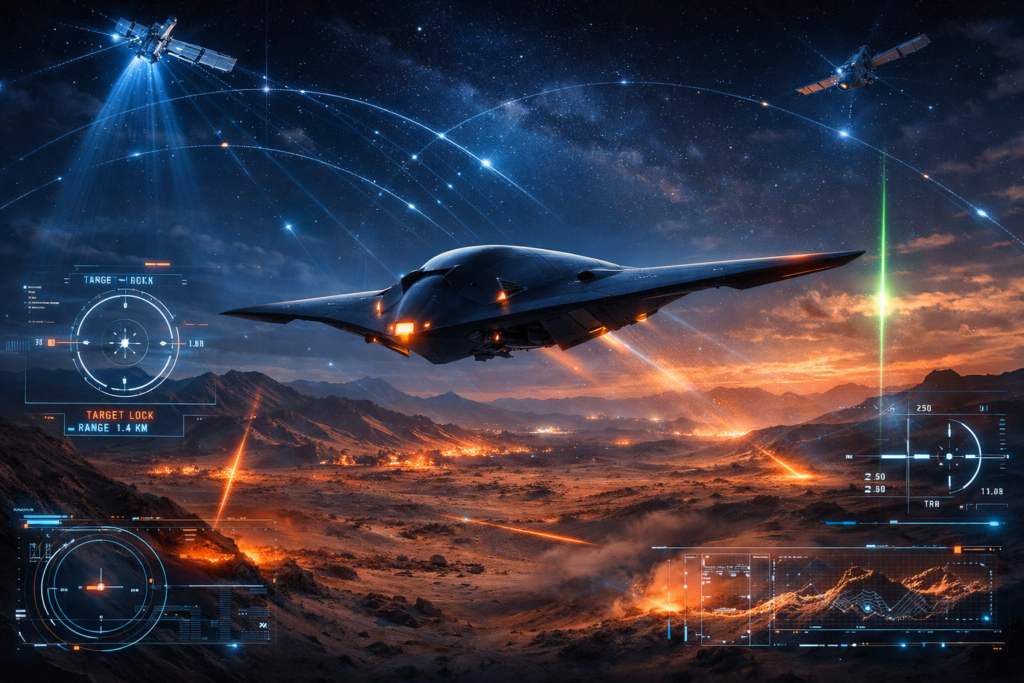
War in the 21st century doesn’t look like it used to. There are no long trench lines or cavalry charges. Instead, US military technology in the Iran war showcases an era where algorithms pick targets, drones fly without pilots, and viruses can disable nuclear centrifuges without a single soldier crossing a border.
The ongoing tensions between the United States and Iran — spanning decades of sanctions, proxy conflicts, targeted strikes, and cyber operations — have made this geopolitical flashpoint the ultimate real-world testing ground for cutting-edge modern warfare technology. In this article, we break down exactly what tools America has deployed or prepared, explain how each one works in plain English, and explore what this means for the future of global conflict.
Table of Contents
- What is Modern Tech Warfare?
- Artificial Intelligence in Targeting & Data Analysis
- Military Drones — Attack & Surveillance
- Stealth Aircraft — F-35 & B-2 Bombers
- Precision-Guided Missiles & Smart Bombs
- Satellite & Space Technology
- Cyber Warfare — Hacking Iran’s Infrastructure
- Laser Weapons & Advanced Defense Systems
- Key Advantages of These Technologies
- Comparison Table
- Cost & Investment in US Military Tech
- Real Examples from the Iran Conflict
- Future of Warfare Technology
- FAQs
- Conclusion
What Is Modern Tech Warfare?
Modern tech warfare, sometimes called fourth-generation warfare or network-centric warfare, is the use of advanced technology — computers, satellites, artificial intelligence, and precision weapons — to fight military conflicts more efficiently and with fewer casualties on the attacking side.
Think of it this way: traditional warfare was about numbers — who had more soldiers, more tanks, more artillery. Modern warfare is about information — who sees the enemy first, who reacts faster, and who can strike with pinpoint accuracy from thousands of miles away.
The United States spends more on defense technology than the next 10 countries combined — and the Iran conflict has been one of the key catalysts for that innovation.
Major Technologies Used by the USA in the Iran War
1. Artificial Intelligence — Targeting & Data Analysis
Artificial Intelligence (AI) is one of the most powerful tools in the US military’s arsenal, and it’s not science fiction anymore. The US military uses AI to process massive amounts of data from satellites, drones, sensors, and intelligence reports in real time.
In the context of the Iran conflict, AI was used to:
- Identify high-value targets — AI cross-references phone signals, movement patterns, and facial recognition data to locate individuals like General Qasem Soleimani before the 2020 drone strike.
- Predict enemy movements — machine learning models analyze historical behavior to forecast where Iranian proxy forces will move next.
- Reduce collateral damage — AI calculates strike angles and timing to minimize civilian casualties, improving mission precision.
The Pentagon’s Project Maven, launched in 2017, is one of the clearest examples — it uses AI to analyze drone footage automatically, flagging objects and people of interest far faster than a human analyst could.
2. Military Drones — Attack & Surveillance
Unmanned Aerial Vehicles (UAVs), commonly called drones, are the most visible symbol of US military technology in the Iran war. They allow American forces to conduct strikes and surveillance missions without risking pilot lives.
Key drones used:
- MQ-9 Reaper — The primary attack drone. It can carry Hellfire missiles, loiter over a target for 27+ hours, and be controlled from a base thousands of miles away. The killing of General Soleimani in January 2020 was carried out by an MQ-9 Reaper.
- RQ-4 Global Hawk — A surveillance drone the size of a commercial jet. It flies at 60,000 feet (above commercial air traffic) and photographs entire cities in a single pass. Iran shot one down over the Strait of Hormuz in June 2019, nearly triggering a full military response.
- Switchblade drones — Small, kamikaze drones that can be launched from a backpack. They dive directly into a target, combining drone and precision missile functions.
3. Stealth Aircraft — F-35 & B-2 Bombers
Stealth technology makes aircraft nearly invisible to radar by using special shapes and materials that absorb or deflect radar waves instead of bouncing them back. This is critical against Iran, which has invested heavily in Russian-supplied air defense systems like the S-300.
- F-35 Lightning II — America’s frontline stealth fighter jet. Deployed to the Middle East multiple times during Iran tensions. It can strike targets deep inside Iran without being detected.
- B-2 Spirit Bomber — A massive flying-wing stealth bomber capable of carrying bunker-buster bombs (like the Massive Ordnance Penetrator) that can destroy underground nuclear facilities — the kind Iran uses at Fordow and Natanz.
- F-22 Raptor — Air superiority stealth fighter, used to escort strike packages and dominate the skies over any theater of conflict.
The US has deployed B-52 bombers, aircraft carriers, and F-35s to the Persian Gulf region multiple times since 2019 — a deliberate signal to Tehran.
4. Precision-Guided Missiles & Smart Bombs
Gone are the days of carpet-bombing entire neighborhoods to hit one target. The US military now uses precision-guided munitions (PGMs) that can hit a specific window of a specific building from 50 miles away.
- JDAM (Joint Direct Attack Munition) — A GPS guidance kit attached to standard bombs, turning them into “smart bombs.” Cost-effective and extremely accurate (within 5 meters).
- Tomahawk Cruise Missiles — Long-range, subsonic missiles launched from ships or submarines. They fly at treetop level to avoid radar detection and can hit targets 1,500 miles away.
- GBU-57 Massive Ordnance Penetrator — A 30,000-pound bunker-buster designed specifically to destroy deeply buried nuclear facilities. It can penetrate 200 feet of reinforced concrete — aimed squarely at Iran’s underground nuclear sites.
- Hellfire missiles — Small, laser-guided missiles typically deployed from drones or helicopters. The Hellfire R9X variant replaces the explosive warhead with a set of blades, designed to kill one target in a car without destroying the vehicle or harming passengers nearby.
5. Satellite & Space Technology
Space is the “high ground” of modern warfare. The US Space Force and NRO (National Reconnaissance Office) operate hundreds of satellites that provide real-time intelligence, GPS navigation, and missile early-warning capabilities.
- Missile detection satellites — Detect the heat signature of ballistic missile launches within seconds. When Iran launched 16 ballistic missiles at Al Asad Air Base in January 2020, US satellites detected them immediately, giving troops time to shelter.
- GPS satellites — Every JDAM bomb, Tomahawk missile, and military vehicle in the Middle East depends on GPS signals from US satellites in orbit.
- Communications satellites — Enable real-time command and control between Washington D.C. and troops on the ground thousands of miles away.
6. Cyber Warfare — Hacking Iran’s Infrastructure
Cyber warfare is fighting a war through computer networks instead of bullets. The US and Israel pioneered this approach specifically against Iran — and it became one of the most consequential covert operations in history.
- Stuxnet (2010) — A computer worm developed jointly by the US and Israel that infected Iran’s nuclear facility at Natanz. It secretly reprogrammed the industrial controllers of uranium enrichment centrifuges, causing them to spin at wrong speeds and destroy themselves — while showing normal readings to Iranian engineers. An estimated 1,000 centrifuges were destroyed. This was a turning point in cyber warfare history.
- Flame malware — A sophisticated espionage virus deployed against Iran, capable of recording audio, screenshots, keystrokes, and network traffic — essentially a digital spy living inside Iranian government computers.
- USCYBERCOM attacks — In 2019, following the downing of the RQ-4 Global Hawk drone, the US Cyber Command launched a retaliatory cyberattack against Iranian computer systems used to control rocket and missile launches.
Cyber warfare is attractive because it causes damage without casualties, is difficult to attribute, and operates below the threshold of traditional armed conflict — reducing the risk of all-out war.
7. Laser Weapons & Advanced Defense Systems
The US military has also deployed defensive technologies to protect troops and assets from Iranian missiles and drones.
- Patriot Missile Defense System — Shoots down incoming ballistic missiles mid-flight. Saudi Arabia uses Patriot systems (US-supplied) to defend against Iran-backed Houthi missile attacks from Yemen.
- THAAD (Terminal High Altitude Area Defense) — Intercepts ballistic missiles during their final descent phase. Deployed to the region as tensions escalated.
- High Energy Laser (HEL) systems — Directed-energy weapons that can shoot down drones and incoming missiles at the speed of light. While not yet fully combat-deployed, these are actively tested in the Middle East theater.
- Iron Dome (US-supported) — Originally an Israeli system, the US funds and supplies components for this short-range rocket defense system, protecting regional allies from Iranian-proxy rocket attacks.
Key Advantages of These Technologies
- Fewer casualties — Drones and precision missiles mean fewer American soldiers in harm’s way.
- Strategic deterrence — The mere existence of these capabilities prevents escalation.
- Rapid response — AI and satellite networks compress the decision-to-strike timeline from hours to minutes.
- Deniability in cyber ops — Digital attacks can be covert, allowing pressure without open warfare.
- Global reach — The US can strike any target in Iran from bases thousands of miles away.
Technology Comparison Table
| Technology | Primary Purpose | Key Advantages | Real Use Case vs. Iran |
|---|---|---|---|
| AI targeting | Intelligence & target ID | Speed, accuracy, reduced error | Soleimani strike targeting via Project Maven |
| MQ-9 Reaper drone | Attack & surveillance | No pilot risk, 27-hr endurance | Baghdad airport strike, Jan 2020 |
| F-35 / B-2 stealth | Strike aircraft | Radar-invisible, deep strike | Gulf deployments as deterrence 2019–2020 |
| JDAM smart bombs | Precision ground strike | GPS accuracy <5m, low cost | Strikes on Iran-backed militias in Iraq/Syria |
| Satellite surveillance | Tracking & early warning | Real-time global coverage | Detected Jan 2020 Iranian missile launches |
| Stuxnet cyberweapon | Infrastructure sabotage | No troops needed, deniable | Destroyed ~1,000 Iranian centrifuges at Natanz |
| Patriot / THAAD | Missile defense | Intercepts mid-flight ballistic threats | Protecting Gulf bases & Saudi Arabia |
| Laser weapons (HEL) | Anti-drone / anti-missile | Speed-of-light, near-zero cost per shot | Testing phase — Middle East theater trials |
Cost & Investment in US Military Tech
- $886 Billion — US defense budget 2024
- $1.7 Trillion — Total cost of the F-35 program
- $30 Million+ — Cost per MQ-9 Reaper drone
- $1.2 Billion — Annual budget of US Cyber Command
The US military’s investment in these technologies isn’t just about one conflict — it’s about maintaining global dominance. The Pentagon’s Third Offset Strategy specifically focuses on AI, autonomy, and cyber capabilities to maintain an edge over rivals. The Iran conflict has served as a live proving ground for many of these investments.
Real Examples from the Iran Conflict
- January 3, 2020 — Killing of Qasem Soleimani: An MQ-9 Reaper drone fired Hellfire missiles at Soleimani’s motorcade at Baghdad International Airport. The operation used satellite surveillance, AI-assisted targeting, and drone precision — no US troops were directly involved in the strike.
- June 2019 — RQ-4 Global Hawk shootdown: Iran used a surface-to-air missile to down a US surveillance drone in international airspace. President Trump authorized a retaliatory cyberattack on Iranian missile control systems rather than a kinetic military strike.
- Stuxnet 2009–2010: The US-Israeli cyber operation destroyed roughly 20% of Iran’s nuclear centrifuges and set back its program by years — all without a single bomb being dropped.
- 2019 — Iran oil tanker attacks: US satellites and surveillance drones tracked Iranian Revolutionary Guard (IRGC) vessels conducting limpet mine attacks on oil tankers, providing photographic evidence used in international forums.
- January 8, 2020 — Iranian missile retaliation: Iran fired 16 ballistic missiles at Al Asad air base in Iraq. US early-warning satellites detected the launches within seconds. All US personnel were evacuated to bunkers before impact — zero US deaths despite massive structural damage.
Future of Warfare Technology
If today’s technology is already this advanced, what comes next? Defense analysts and Pentagon planners are focused on several emerging capabilities:
- Fully autonomous weapons (lethal autonomous systems): AI-powered weapons that can identify, decide, and engage targets without human approval. Currently controversial but actively developed.
- Hypersonic missiles: Missiles traveling at Mach 5+ (3,800+ mph) that are too fast for current missile defense systems to intercept. Both the US and Iran are investing in this area.
- Swarm drones: Hundreds of small AI-coordinated drones acting as a single weapon system — overwhelming enemy defenses through sheer numbers.
- Quantum computing in warfare: Breaking enemy encryption and running simulations of conflict scenarios at unprecedented speed.
- Space warfare: Satellites are now considered military assets. Anti-satellite weapons (ASAT) could blind an enemy’s GPS and communication network in seconds.
- Deepfake & information warfare: AI-generated video and audio used to deceive enemy leadership or populations — a new front in psychological operations.
FAQs
Q: What US military technology was used to kill Soleimani?
The strike used an MQ-9 Reaper drone firing AGM-114 Hellfire missiles. The targeting involved satellite surveillance and AI-assisted intelligence analysis to confirm identity and location in real time.
Q: What is Stuxnet and why does it matter?
Stuxnet was a computer worm jointly created by the US and Israel that sabotaged Iran’s nuclear centrifuges. It’s considered the world’s first major offensive cyberweapon used in warfare and permanently changed how nations think about digital conflict.
Q: How does the US use AI in warfare against Iran?
AI is used for intelligence analysis (processing satellite imagery and signals), target identification, predictive modeling of enemy movements, and optimizing strike parameters to minimize civilian casualties. Project Maven is the key program.
Q: Can Iran shoot down stealth aircraft like the F-35?
Iran has Russian-supplied S-300 air defense systems, which are capable against conventional aircraft. Stealth aircraft like the F-35 are significantly harder — though not impossible — to detect. This asymmetry is a major reason the US deploys stealth jets to the region.
Q: Has the US used laser weapons against Iran?
Not in direct combat yet. High-energy laser systems are being tested in the Middle East theater and have proven effective against drones in trials. Full combat deployment is expected within the next few years.
Q: Why didn’t the US bomb Iran after the 2020 drone shootdown?
President Trump authorized a kinetic strike but then called it off, citing potential casualties. Instead, the US responded with a cyberattack on Iranian missile systems — illustrating the preference for non-kinetic responses when possible.
Q: What is cyber warfare and how does the US use it against Iran?
Cyber warfare involves using computers to attack enemy infrastructure — power grids, nuclear facilities, military command systems. The US has used it against Iran to sabotage nuclear centrifuges (Stuxnet), conduct espionage (Flame), and disable missile systems without firing a single shot.
Q: How much does a drone strike cost compared to a traditional military operation?
A drone strike can cost tens of thousands of dollars in munitions versus hundreds of millions for a traditional manned air campaign with aircraft carriers, escort fighters, logistics, and support personnel. This cost efficiency is a major driver of drone warfare adoption.
Conclusion
The US–Iran conflict has become the defining showcase of modern warfare technology. From the AI-assisted targeting that guided a Reaper drone to a single motorcade in Baghdad, to the invisible Stuxnet virus that dismantled a nuclear program without a single soldier crossing a border — America’s technological edge has fundamentally reshaped what conflict looks like in the 21st century.
The most significant takeaway isn’t just the power of any single weapon or system — it’s how these technologies work together. Satellites feed data to AI. AI guides drones. Drones deliver precision munitions. Cyber operations soften defenses. Stealth aircraft ensure the mission survives detection. It’s a seamlessly integrated kill chain that no adversary in 2024 can fully counter.
As we move forward, the race isn’t just about having the biggest military — it’s about who can think faster, see clearer, and strike smarter. In that race, US military technology in the Iran war has set the global standard. The battlefield has moved from the desert to the digital realm — and the next major conflict may be decided before a single shot is ever fired.
Also read latest article :
- Agentic AI in 2026: How AI Agents Are Changing the Way We Work, Live, and Think
- US Military Technology in the Iran War: AI, Drones, Stealth & Cyber Warfare Explainedv
- 10 Simple Ways to Protect Your Phone from Hackers in 2026
- Why Your Phone is Slow and 10 Easy Ways to Fix It
- What is Artificial Intelligence (AI)? Simple Explanation for Beginners
Leave a Reply