
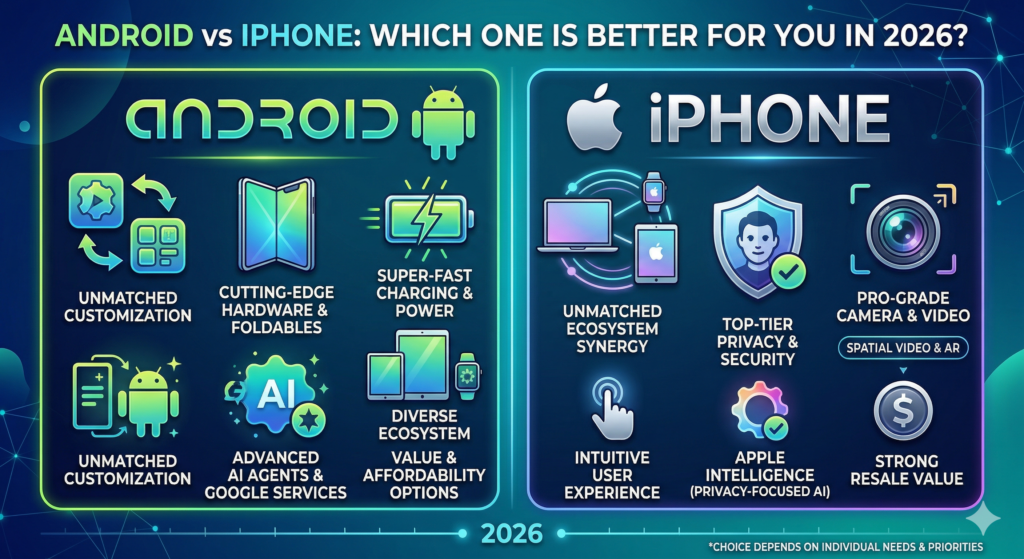
Why Your Choice Matters More in 2026
In 2026, your smartphone is no longer just a communication tool; it is an extension of your cognitive abilities. With the rise of “Agentic AI,” your phone now performs tasks for you—booking flights, summarizing weeks of emails, and even managing your smart home without you lifting a finger.
The choice between Android vs iPhone now dictates which AI ecosystem you live in. Apple Intelligence has become deeply integrated into the iOS experience, focusing on privacy and “it just works” automation. On the flip side, Android has doubled down on raw power and open-source AI flexibility, allowing you to choose between Google’s Gemini, Samsung’s Galaxy AI, or even localized open-source models.
Pro Tip: Before you buy, look at your desk. If you have an iPad and a Mac, the iPhone is almost a non-negotiable. If you love Windows and use a variety of brands, Android offers a freedom you just can’t get elsewhere.
The Great Comparison: 40 Deciding Factors
To help you decide, I’ve broken down the Android vs iPhone debate into every possible category. Here is the ultimate 2026 checklist.
1. The AI Integration Battle
In 2026, AI isn’t a “feature”—it’s the core. iPhones now use the A20 Pro chip to run massive language models locally, ensuring your data never leaves the device. Android, however, offers “Agentic AI” that can actually log into your apps and perform actions, like ordering your favorite pizza when it senses you’re working late.
- Example: On a 2026 Android flagship, you can say, “Book a table for two at that Italian place I liked last week,” and the AI handles the app, the reservation, and the calendar invite.
2. Battery Technology and Longevity
We’ve finally seen the mainstream arrival of silicon-carbon batteries. Many 2026 Android phones, like the OnePlus 16 or Realme P4 Power, are shipping with 7,000mAh to 10,000mAh batteries in slim bodies. iPhones have improved, but they still prioritize efficiency over raw capacity.
- Tip: If you are a “power user” who hates chargers, look for Android phones with 80W+ charging. They can hit 100% in under 30 minutes.
3. The Foldable vs. Slab Debate
Apple finally entered the foldable market in late 2025/early 2026 with the “iPhone Fold.” It’s polished and expensive. Meanwhile, Android brands like Samsung and Google are on their 8th generation of foldables, offering tri-fold designs and creaseless screens that feel like sci-fi.
- Example: Use a Google Pixel 10 Pro Fold if you want a tablet that fits in your jeans. Use an iPhone 18 Pro if you prefer the reliability of a classic “slab” design.
4. Camera Capabilities: Zoom vs. Realism
The Samsung Galaxy S26 Ultra has pushed the limits with its 200MP sensor and AI-assisted 100x zoom that actually looks clear. iPhone 18 Pro, however, has introduced a variable aperture lens, giving photographers “real” bokeh (background blur) rather than just software-generated effects.
- Tip: If you shoot a lot of video for social media, the iPhone’s “Cinematic Mode” in 2026 is still the gold standard for stabilization and color.
5. Ecosystem Connectivity
The “Blue Bubble” vs. “Green Bubble” war is mostly over thanks to RCS (Rich Communication Services) being fully adopted. However, the Apple Watch and AirPods still work best with an iPhone. Android has caught up with “Fast Pair” and “Nearby Share,” making it easy to swap files between a Samsung phone and a Lenovo laptop.
6. Customization and Personal Expression
Android 17 allows for “Dynamic Theming” that changes every icon, font, and widget based on your mood or the time of day. iPhone has added more widgets, but it still feels like a curated garden. You can’t move icons wherever you want without some friction.
- Example: On Android, you can install a completely different “Launcher” (like Nova) to make your phone look like a 90s GameBoy. On iPhone, you’re stuck with the grid.
7. Price and Value Retention
This is a big one. An iPhone 18 Pro will likely hold 60-70% of its value even after two years. Android phones—even great ones like the Xiaomi 16—tend to drop in value quickly. However, you can find a high-quality Android phone for $300, whereas a “cheap” new iPhone still starts around $700.
8. Security and Privacy Philosophy
Apple’s “App Tracking Transparency” is legendary. They treat privacy as a human right. Google has made massive strides with the “Android Private Space” feature in 2026, allowing you to hide entire apps and data behind a separate biometric lock.
9. Gaming Performance
With the Snapdragon 8 Gen 5 and Apple’s A20 chip, both platforms are essentially handheld consoles. The difference? Android has better cooling systems (some even have internal fans), while iPhone has “exclusive” AAA titles like Resident Evil or Assassin’s Creed ported directly from consoles.
10. Software Update Longevity
In 2026, Google and Samsung now match Apple by offering 7 years of guaranteed OS updates. This means a phone bought today will still be “modern” in 2033. This has leveled the playing field significantly.
11. Screen Brightness and Outdoor Use
We are seeing “Tandem OLED” displays reaching 4,000 to 5,000 nits of peak brightness. Whether it’s an iPhone 18 or a Pixel 11, you can now read your emails under the direct Sahara sun without squinting.
12. Durability: Titanium and Gorilla Armor
Most flagships in 2026 use Grade 5 Titanium frames. They are lighter and tougher. Android manufacturers have also started using “Gorilla Glass Armor” which reduces reflections by 75%, making the screen look like paper.
13. Sideloading and App Freedom
If you want to install apps that aren’t on the official store (like specialized emulators or niche tools), Android is still the king. While the EU has forced Apple to allow some “Alternative App Stores,” it’s still a clunky process compared to the “Download and Install” ease of Android.
14. Biometrics: Face ID vs Fingerprint
Apple’s Face ID is now mostly hidden under the glass, but it’s still the only way in. Android offers ultrasonic fingerprint sensors under the screen—which are incredibly fast—plus face unlock as a backup.
- Tip: If you wear a mask or sunglasses often, the Android fingerprint sensor is usually more convenient.
15. Charging Standards (Qi2 and Beyond)
Magnetic charging (MagSafe) is no longer an Apple exclusive. Most 2026 Android phones now support Qi2, meaning all those cool magnetic wallets and car mounts work on both platforms.
16. Repairability
Thanks to new “Right to Repair” laws, both Apple and Samsung have made it easier to swap your own battery or screen. Android brands like Nothing or Fairphone still lead the way here, with modular designs that you can take apart with a simple screwdriver.
17. Professional Video Tools
iPhone 18 Pro supports “Log” recording directly to external SSDs via USB-C. This makes it a legitimate B-camera for filmmakers. Android phones like the Sony Xperia 1 VII offer manual “Pro” controls that feel like using a real DSLR.
18. Messaging Experience
Now that Apple supports RCS, sending high-quality videos and photos between Android vs iPhone is seamless. You finally get read receipts and typing indicators regardless of which phone your friend has.
19. Satellite Connectivity
In 2026, “Emergency SOS via Satellite” isn’t just for emergencies. Both platforms now allow for basic “Off-Grid Messaging.” If you’re hiking in a dead zone, you can still text your family to say you’re safe.
20. The “Bloatware” Factor
iPhones come with Apple apps, but they are generally high quality. Cheap Android phones often come with pre-installed “junk” apps. If you want a clean Android experience, you have to stick to the Pixel or “Pro” models.
21. Multitasking: Split Screen vs Stage Manager
Android has had split-screen for a decade, and in 2026, it’s perfected. You can watch YouTube while browsing Reddit easily. iPhone is still hesitant about true split-screen, though “Picture-in-Picture” has improved.
22. Accessibility Features
Both platforms are incredible here. From “Personal Voice” (where the phone learns to speak in your voice) to “Live Captions” for every video, tech in 2026 is truly for everyone.
23. Smart Home Control
Apple HomeKit is incredibly secure but supports fewer devices. Android’s integration with Google Home and “Matter” (the new smart home standard) means you can control almost any smart light or plug on the market.
24. File Management
If you like to treat your phone like a computer—dragging and dropping files, using folders, and plugging in USB drives—Android is the winner. iPhone’s “Files” app is better than it used to be, but it still feels “sandboxed.”
25. The “Cool” Factor
Let’s be real: Brand image matters. In some circles, the iPhone is a status symbol. In others, owning a unique foldable like the “Motorola Signature” shows you’re a tech-savvy trendsetter.
26. International Travel (eSIM vs Physical SIM)
The SIM tray is officially dead on high-end iPhones in 2026. Most Android flagships still offer a “Hybrid” slot (one eSIM, one physical). If you travel to countries where getting a local physical SIM is easier, Android is more practical.
27. AR and VR Integration
With the Apple Vision Pro now being a few years old, the iPhone 18 has deep “Spatial Video” integration. Android has countered with “Android XR” devices that turn your phone into a portable AR workstation.
28. Haptics: The “Feel” of the OS
The “Taptic Engine” in iPhones still provides the most satisfying clicks and thumps in the industry. High-end Androids like the iQOO 15 or Galaxy S26 have narrowed the gap, but iPhone still feels more “organic.”
29. Voice Assistants (Siri vs Gemini)
Siri has received a massive AI “brain transplant” in 2026, making her much more capable. However, Google Gemini is essentially a genius in your pocket—it can summarize your emails, write code, and plan your entire week better than any other assistant.
30. Aesthetics: Color and Finish
Apple is leaning into “Coffee” and “Deep Red” tones this year. Android manufacturers are experimenting with “Electrochromic Glass” that can change the color of the phone’s back at the press of a button.
Internal Linking Opportunity
Also read: [Top 10 AI Features You Need to Try in 2026]
Frequently Asked Questions (FAQ)
Q1: Which phone has the best battery life in 2026?
Currently, mid-range and flagship Android phones using Silicon-Carbon batteries (like the OnePlus 16 or Realme P4 Power) are leading the pack, often lasting 2.5 to 3 full days on a single charge.
Q2: Is the iPhone 18 worth the upgrade from an iPhone 15?
Yes. The jump to the 2nm A20 chip and the under-display Face ID (on Pro models) makes the iPhone 18 feel like a completely new generation compared to the iPhone 15.
Q3: Can I use Apple Watch with an Android phone?
Technically, no. While some third-party workarounds exist, you lose 90% of the functionality. If you love your Apple Watch, you should stay with iPhone.
Q4: Are Android phones still “laggy” after a year?
Not anymore. With UFS 4.1 storage and 12GB+ of RAM becoming standard, flagship Android phones stay as fast as iPhones for years.
Q5: Which platform is better for kids?
iPhone’s “Screen Time” and “Family Sharing” features are generally more intuitive for parents to manage, though Google’s “Family Link” has become very robust in 2026.
The Final Verdict: Which One Should You Buy?
So, we come to the end of the road. Android vs iPhone: Which one is better for you in 2026?
If you want a device that disappears into your life, works seamlessly with your other gear, and holds its resale value like a gold bar, the iPhone 18 (or the new iPhone Fold) is your best bet. It is the choice of stability, luxury, and “peace of mind.”
However, if you want a device that redefines what a phone can do, if you want a 9,000mAh battery that never dies, or a screen that folds into a tablet, Android is where the innovation is happening. In 2026, Android isn’t the “budget” choice; it’s the “power” choice.
My advice? Go to a store and hold them. Feel the weight. See how the AI responds to your voice. Your phone is the most personal object you own—make sure it feels like you.
Ready to make the switch? Or are you staying loyal to your brand? Let me know in the comments below!
Also read : “Top 10 Latest Technology Trends in 2026“
Leave a Reply to Speed Up Your Phone: 10 Easy Fixes – techsawai.com Cancel reply